The Setup
HarborTechAI places engineers across 4+ global regions. Finding and reaching the right candidates at scale was a constant bottleneck — the kind that doesn't show up in a spreadsheet but eats your week anyway.
Most Staffing Firms Are Still Copy-Pasting
The standard playbook: a recruiter finds a candidate, copies their name into a template, swaps in a few details, hits send. Repeat 200 times. The reply rates reflect it — 8% if you're lucky, 12% if your template is good.
We didn't want to optimize the template. We wanted to replace the whole thing.
What We Built
The sourcing pipeline is an AI agent that runs the full cycle without a human in the loop:
- →Finds candidates matching a given role and criteria from our talent network and external sources
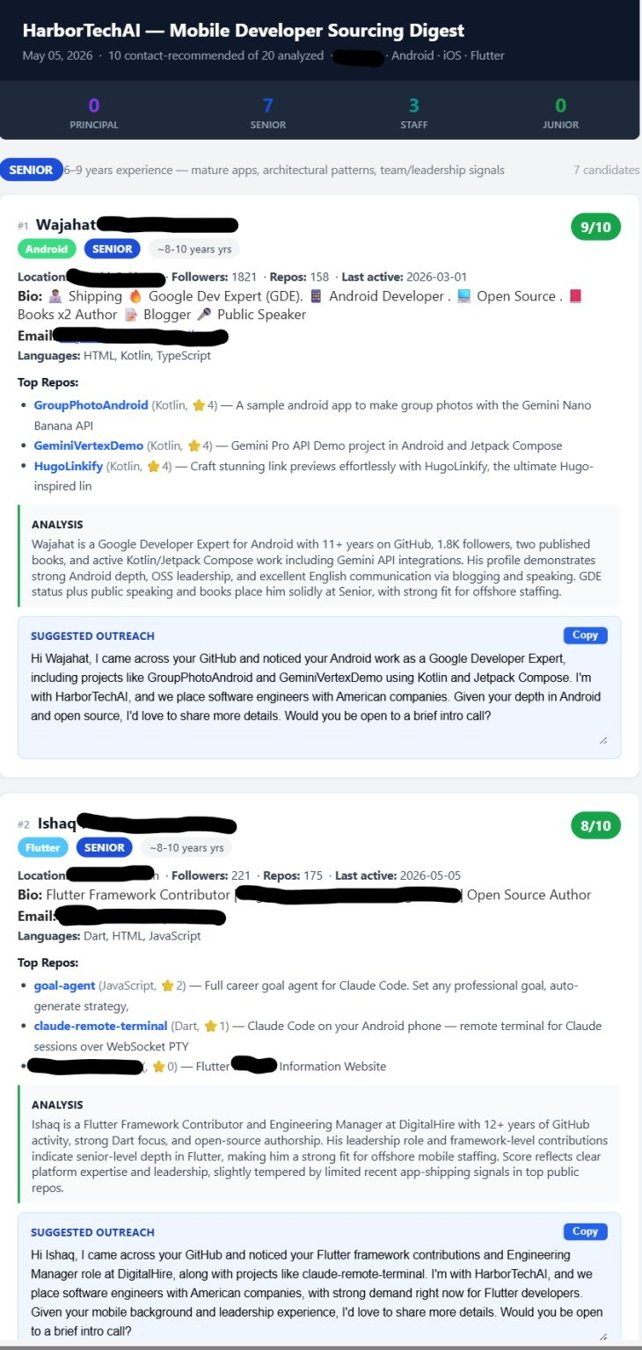
- →Researches each candidate's background — what they've built, where they've worked, what they're likely interested in
- →Writes a personalized outreach message for each candidate based on that research — not a template with swapped-in variables
- →Sends the outreach and tracks responses
The key distinction: the message isn't personalized in the mail-merge sense. The agent actually reads the candidate's profile and writes something specific to them. It knows what projects they've worked on, what technologies they care about, and what kind of opportunity would actually be relevant. That's why the reply rate is 53% — not because of a better subject line, but because the message is worth replying to.
What Changed
- →Manual sourcing time: eliminated from our workflow entirely
- →Reply rate: from ~10% (template-based) to 53%
- →Outreach volume: increased significantly without adding headcount
- →Candidate quality: better, because the agent filters and scores before reaching out
What We Learned
The biggest lesson: the hardest part wasn't the technology. It was defining what "a good candidate" means precisely enough for the agent to make the right calls. Once we nailed that, the rest followed.
The second lesson: reply rate alone isn't the metric. We track reply-to-interview rate and interview-to-placement rate downstream. A 53% reply rate is only valuable if the replies are from the right people. Ours are, because the agent doesn't reach out to people it can't place.
The third: the agent gets better over time. Every placement gives us more data about what good looks like — and that feeds back into how the agent evaluates candidates.
Want This for Your Recruiting Workflow?
The same approach works for any business that needs to reach the right people at scale — recruiting, sales, partnerships. Book a scoping call and let's talk about what it would look like for you.
Book a Scoping Call →