The Setup
HarborTechAI runs lean — founder-operated, no full-time staff. That's a feature, not a bug. But it means every strategic decision gets made by one person, with one perspective, often under time pressure. Pricing models, positioning pivots, what to build next, whether to take on a new type of engagement — these are the decisions that compound. Getting them wrong doesn't show up immediately. It shows up six months later.
The Problem With Making Big Decisions Alone
It's not that solo founders make bad decisions. It's that they make incomplete ones. When you're the CFO, CTO, CRO, COO, and operator all at once, you default to the angle you're thinking about that day. If you've been deep in product work, you think like a builder. If you just had a good sales call, you think like a closer. What you rarely get is all five perspectives in the same room, looking at the same question, at the same time.
Real advisory boards fix this — but they're expensive, slow to convene, and often give advice that's too removed from your actual current state. They don't know how many candidates are in your pipeline right now. They don't know what you built last week or what's still on the roadmap. They're advising on a description of your business, not the business itself.
What We Built
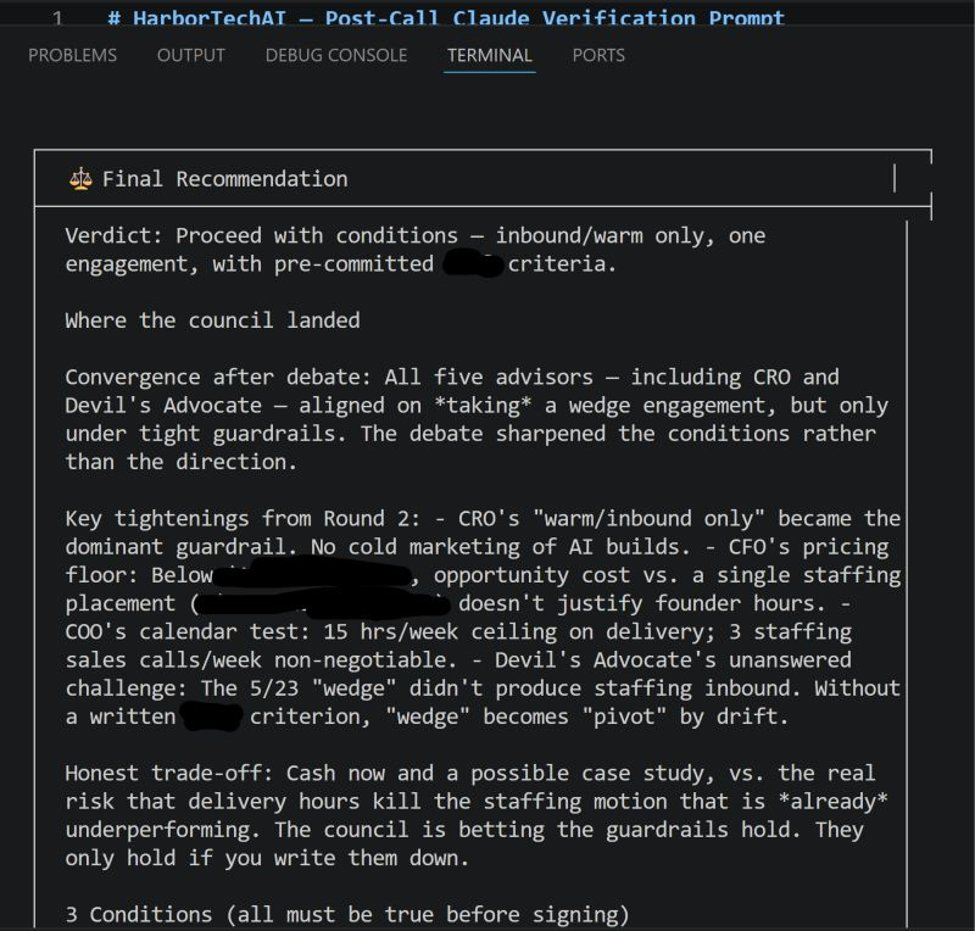
The Advisory Council is a multi-agent system where five advisors — each with a distinct role and mandate — independently analyze any question, then debate each other, then produce a synthesized verdict. Before any advisor speaks, they pull live data:
- →Current pipeline: how many candidates are active, what stage they're at, what's been placed
- →Roadmap status: what's been built, what's in progress, what's still to do
- →Past decisions: what the council recommended before, so nothing contradicts or forgets prior rulings
Then the debate runs in two rounds. Round one: all five advisors form independent positions simultaneously — no one sees anyone else's take yet. Round two: everyone reads all five positions and can push back, revise, or highlight what was missed. A neutral synthesizer then weighs both rounds and delivers a clear verdict — Proceed, Proceed with conditions, or Don't proceed — plus exactly three next steps or conditions.
The Five Advisors
On the pricing session: "The build price is underpriced by 50–75%. The retainer doesn't cover actual incident costs at this engagement depth. Publishing a rate card before a single delivered engagement is a financial unforced error."
On the same session: "'Production-ready in 4 weeks' assumes a scope that has no delivery track record to calibrate against. That timeline is the risk, not the build itself."
On a positioning question: "Leads are converting on the sourcing agent story, not the broad platform pitch. Narrowing the homepage message would shorten the sales cycle, not hurt it."
On adding a new service line: "You have two active builds and one candidate in final stages. Adding a third service type right now means none of the three get full attention. Sequence matters more than scope."
On the pricing session: "Two weeks ago this council recommended validating before scaling. You're now proposing to publish pricing before a single engagement has closed. That's a direct contradiction — what changed?"
What the Output Actually Looks Like
When we ran the council on our AI agent pricing model, the CFO came back with specific numbers: the proposed build price was underpriced by 50-75%, the retainer was too low to cover actual incident costs, and fixed pricing before a single delivered engagement was a financial unforced error. The CTO flagged that "production-ready in 4 weeks" was an aggressive scope with no delivery track record to calibrate against. The Devil's Advocate pointed out we were escalating to AI-primary positioning while still at zero placements — contradicting a recommendation the council had made two weeks earlier.
The verdict: run T&M-capped engagements on the first two builds before publishing a rate card. That's the decision we followed. The website you're reading right now reflects it — no public pricing, scoped per engagement.
What Changed
- →Big decisions get five angles simultaneously, not one angle under pressure
- →Advisors work from real current data — not a description of the business, but the actual pipeline and roadmap
- →Past decisions are on record — the council knows what it recommended before and can flag contradictions
- →Every session saved to a permanent log — a record of how decisions were made and why
- →The verdict is a clear action, not a memo — Proceed or Don't proceed, with exactly three conditions attached
What We Learned
The Devil's Advocate is the most valuable advisor in the system. It's easy to build an advisory council that validates your instincts. The whole point is to have something that pushes back — that asks the question you didn't want to ask yourself. The uncomfortable pushback is where the value is.
The live data access matters more than we expected. An advisor without context gives generic advice. An advisor that knows you have 0 placements and 3 candidates in stage 2 right now gives specific advice. The specificity is what makes it useful rather than just reassuring.
Making a Big Call Without Enough Perspectives?
If your team is making strategic decisions without enough angles — pricing, positioning, build vs. buy, when to hire — this is the kind of thing we can build for your operation. Book a scoping call and let's talk through what it would look like.
Book a Scoping Call →