The Setup
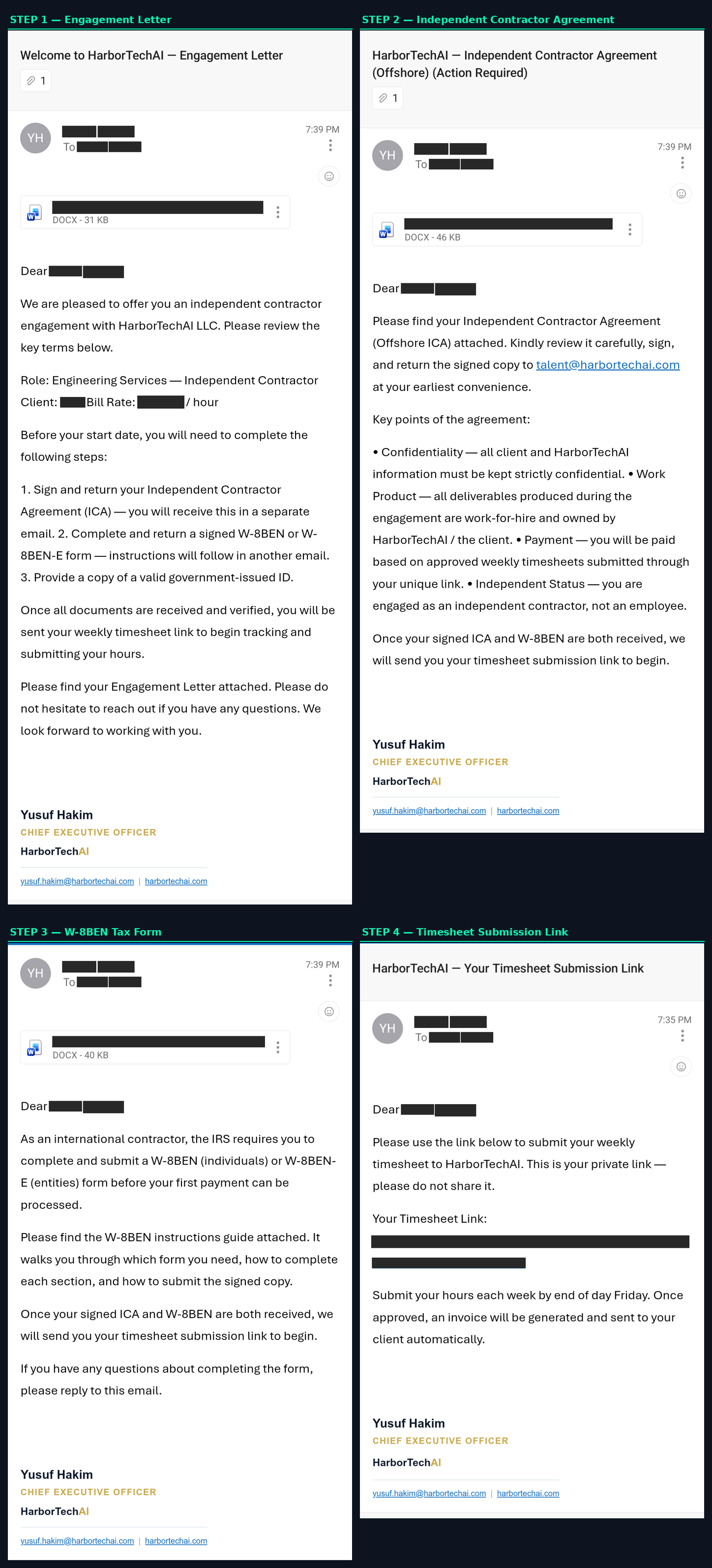
Every consultant we place receives three documents before their engagement begins: an Engagement Letter that sets terms and expectations, an Independent Contractor Agreement that governs the legal relationship, and a W-8BEN guide for tax compliance. Each document has to go out in the right order, to the right person, with the right details filled in — and the ICA has two variants depending on whether the consultant is offshore or onshore.
The Manual Version Had Too Many Moving Parts
Confirm a placement. Open the document folder. Figure out whether this consultant is offshore or onshore — which determines which ICA template applies. Pull the right template. Fill in their name, role, rate, start date. Attach everything. Draft the email. Send. Wait. Follow up when signatures don't come back.
The Engagement Letter has to go first — it sets the context for everything that follows. The ICA can only go out after the letter is acknowledged. The W-8BEN guide comes last. Getting the order wrong creates confusion. Getting the variant wrong creates compliance problems. A tired person on a Friday afternoon makes both mistakes.
What We Built
When a consultant is confirmed in the pipeline, the automation handles the full three-step sequence:
- →Engagement Letter goes out first — pre-filled with the consultant's name, role, rate, and start date pulled from the pipeline tracker
- →Independent Contractor Agreement follows once the letter is acknowledged — automatically selects the offshore or onshore variant based on the consultant's location
- →W-8BEN instructions close the sequence — sent once the ICA is signed, covering the tax form required for all offshore engagements
The sequence is enforced, not assumed. The automation won't send the ICA before the Engagement Letter is out. It won't send the W-8BEN guide before the ICA is signed. Every step has a clear trigger and a clear condition, and the system tracks each consultant's position in the sequence independently.
The Offshore vs. Onshore Problem
The ICA variant matters more than it looks. An offshore consultant has a different governing law clause, different tax treatment, and different compliance requirements than an onshore one. The templates are similar enough to confuse someone moving fast, and different enough that sending the wrong one is a real problem — not just an embarrassment.
The automation reads the consultant's location from the pipeline and selects the correct variant without any human decision point. There's no dropdown to forget, no column to check manually. The right document goes out because the system knows which one to send.
What Changed
- →Document prep time per consultant: from ~1 hour to triggered automatically on confirmation
- →Wrong ICA variant sent: zero since automation went live
- →Out-of-order document sends: eliminated — the sequence is enforced
- →First impression on consultants: consistent and professional from day one of the relationship
What We Learned
The hardest part was writing down the rules that were previously in someone's head. What exactly determines offshore vs. onshore? What if a consultant has dual citizenship? What if the rate changes after the Engagement Letter goes out but before the ICA is signed?
Every edge case needed a written answer before the automation could handle it reliably. That process — of making implicit rules explicit — turned out to be as valuable as the automation itself. The process got cleaner just by having to define it.
Have a Document Workflow That's Eating Your Week?
If you have a multi-step process with clear inputs and decision logic, it can probably be automated. Book a scoping call and we'll tell you if it's feasible and what it would take.
Book a Scoping Call →